

Vitalik Buterin Explores Biometric Technology For Blockchain

Vitalik Buterin, the co-founder of Ethereum and a highly influential figure in the cryptocurrency space, recently expressed his views on biometric technology’s role within the blockchain and specifically Ethereum.
He was particularly interested in Worldcoin, a new cryptocurrency project led by OpenAI Inc. CEO Sam Altman. Worldcoin utilizes an innovative iris-scanning device named “the Orb” to authenticate user identities.
Worldcoin aims to tackle the “unique-human problem” or proof of personhood. This refers to the challenge of verifying that every account on a decentralized network is controlled by an individual human being.
Worldcoin’s Orb has faced criticism and skepticism within the crypto community. Concerns raised encompass the potential privacy and security risks associated with biometric data, as well as the feasibility and scalability of the Orb device itself.
The project primarily strives for fair and inclusive distribution of resources and opportunities among users while prioritizing their anonymity. But, some individuals question the suitability of relying on biometrics to prove personhood.
Buterin’s Analysis Of Biometric Technology
Vitalik Buterin, in his blog post titled “The Three Transitions,” shared his insights on biometric technology along with other key aspects of Ethereum’s development. These include layer-two scaling, smart wallets, and privacy considerations.
He maintained that there isn’t a one-size-fits-all solution for proof of personhood; instead, different paradigms exist with varying trade-offs. He also explored the potential of combining them for optimal results.
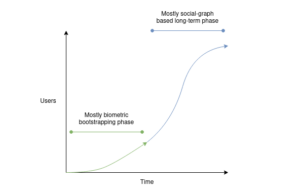
He suggested that using biometrics could serve as a viable short-term solution. Biometrics offer ease of use and verification. However, they come with drawbacks such as susceptibility to coercion, corruption, and potential data leaks.
In contrast, he proposed social-graph-based systems for the long term. These systems rely on social connections and reputation, making them more robust and decentralized.
Buterin acknowledged the efforts of several teams working on privacy-enhancing solutions for proof of personhood. This includes projects like BrightID and Idena.
He emphasized the importance of vigilance within the community, urging them to demand open-source code, third-party audits, and accountability mechanisms from any project claiming to offer biometric solutions.
Related Reading | The Resurrection of a Dormant Bitcoin Wallet: $31 Million Worth of Mystery
Furthermore, he advocated for increased diversity and innovation across three categories of proof-of-personhood: biometrics, social graphs, and zero-knowledge proofs.
Buterin’s analysis has ignited extensive discussions and debates concerning the future of blockchain technology, Ethereum, as well as the pivotal role of biometric technology within the crypto realm.

RELATED STORIES
MORE ON NEWS
Dogecoin Price Tumbles Amid Geopolitical Tensions and Market Pressure
Dogecoin Drops as Global Uncertainty Rattles Crypto Markets The price of Dogecoin has seen a sharp decline over the past week, falling over 13% amid a broader cryptocurrency sell-off driven by escalating geopolitical tensions in the Middle East and cautious signals from the U.S. Federal Reserve. This drop puts the popular memecoin back in the […]

Ethereum vs. Cardano: Which Crypto Offers the Best Long-Term Potential?
The cryptocurrency landscape is constantly evolving. Two major players in the smart contract space, Ethereum and Cardano, compete for dominance. Cardano recently surged, jumping 62% in a single day and rising 48% over the past week. Meanwhile, Ethereum, the long-established leader in decentralized applications, dropped 11% over the past seven days despite minor recoveries. With […]

Bitcoin Stabilizes – Is a $100K Breakout Next?
Bitcoin price stabilizes as sellers lose momentum, signaling a possible recovery. Bitcoin (BTC) has recently stabilized after a significant price drop. It found support at the 200-day simple moving average (SMA), a key level for buyers. The cryptocurrency market has been highly volatile, with BTC briefly dropping below $90,000 before recovering. This movement has left […]


RELATED STORIES
MORE ON NEWS
Dogecoin Price Tumbles Amid Geopolitical Tensions and Market Pressure
Dogecoin Drops as Global Uncertainty Rattles Crypto Markets The price of Dogecoin has seen a sharp decline over the past week, falling over 13% amid a broader cryptocurrency sell-off driven by escalating geopolitical tensions in the Middle East and cautious signals from the U.S. Federal Reserve. This drop puts the popular memecoin back in the […]
Ethereum vs. Cardano: Which Crypto Offers the Best Long-Term Potential?
The cryptocurrency landscape is constantly evolving. Two major players in the smart contract space, Ethereum and Cardano, compete for dominance. Cardano recently surged, jumping 62% in a single day and rising 48% over the past week. Meanwhile, Ethereum, the long-established leader in decentralized applications, dropped 11% over the past seven days despite minor recoveries. With […]
Bitcoin Stabilizes – Is a $100K Breakout Next?
Bitcoin price stabilizes as sellers lose momentum, signaling a possible recovery. Bitcoin (BTC) has recently stabilized after a significant price drop. It found support at the 200-day simple moving average (SMA), a key level for buyers. The cryptocurrency market has been highly volatile, with BTC briefly dropping below $90,000 before recovering. This movement has left […]