

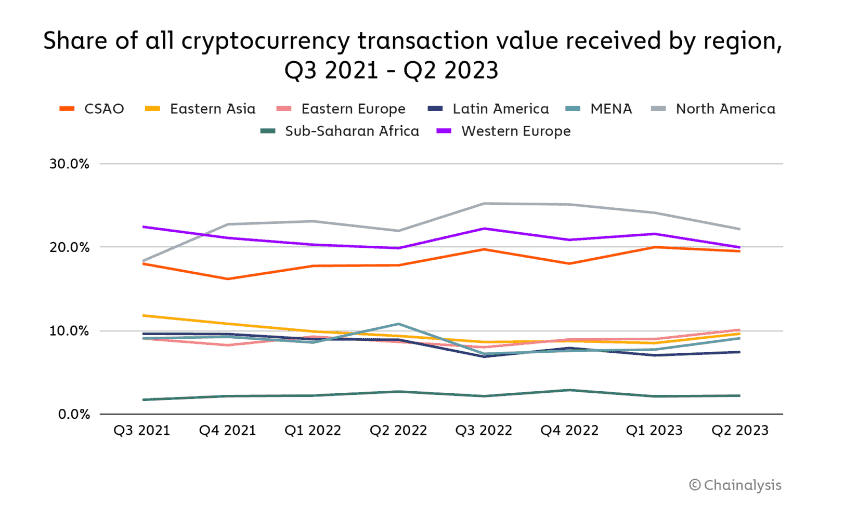
A recent report by Chainalysis has highlighted the remarkable growth and resilience of Sub-Saharan Africa in the crypto market. Despite accounting for only 2.3% of the global cryptocurrency trading volume, the region has demonstrated impressive progress. The report spans from July 2022 to June 2023, providing valuable insights into this area’s unique digital currency landscape.

Nigeria emerged as the largest digital currency market in Sub-Saharan Africa, boasting a trading volume of almost $60 billion. South Africa closely follows with a market size of $20 billion. Kenya, Mauritius, and Ghana secure the third, fourth, and fifth positions respectively in this thriving market.
Sub-Saharan Africa is notable for its preference for centralized exchanges, handling over half of the digital currency transactions in the region. What sets this market apart is its strong emphasis on retail participation, with many transactions falling below the $1 million threshold. This characteristic distinguishes it from other global regions.
Diversification Amidst Crypto Price Volatility
The report also emphasizes the significant impact of digital currency on the economies of the region, particularly in countries like Nigeria. Notably, Nigeria ranks second on the Global Crypto Adoption Index. Many countries in Sub-Saharan Africa are turning to Bitcoin due to concerns over rising inflation and mounting debt.
In June 2022, Ghana experienced a significant inflation rate of 29.8%, marking its highest level in two decades. This economic turmoil led to a surge in Ghanaians exploring alternative avenues like Bitcoin for preserving their wealth.
Recent trends suggest a growing preference for stablecoins over Bitcoin. The reason behind this shift is Bitcoin’s price volatility. Market experts argue that investors are increasingly inclined to diversify their holdings by incorporating stablecoins alongside Bitcoin, thereby mitigating risks associated with its fluctuating value.

Nigeria, the most populous country in Sub-Saharan Africa, has encountered economic challenges. These include two major recessions since 2016. In addition, there has been a recent crisis with the Naira and high inflation rates in the country. As a result, interest in digital currency as a feasible financial alternative has been steadily growing.
Regulatory measures have been instrumental in shaping the crypto landscape across Sub-Saharan Africa. Notably, South Africa has emerged as a frontrunner, implementing robust regulations that offer legal clarity and stimulate trading activities. Moreover, Kenya and Mauritius are making significant strides in developing crypto legislation to support the growth of cryptocurrency businesses.

However, rising amidst numerous challenges, the digital currency industry in Sub-Saharan Africa thrives. This upward trajectory is fueled by regulatory clarity, consumer confidence, and the commitment of local crypto enterprises to comply with regulations.
Related Reading | The Taliban Crackdown Has Stalled Afghanistan’s Cryptocurrency Market

Ammar Raza
Associate editorRELATED STORIES
MORE ON NEWS
Dogecoin Price Tumbles Amid Geopolitical Tensions and Market Pressure
Dogecoin Drops as Global Uncertainty Rattles Crypto Markets The price of Dogecoin has seen a sharp decline over the past week, falling over 13% amid a broader cryptocurrency sell-off driven by escalating geopolitical tensions in the Middle East and cautious signals from the U.S. Federal Reserve. This drop puts the popular memecoin back in the […]

Ethereum vs. Cardano: Which Crypto Offers the Best Long-Term Potential?
The cryptocurrency landscape is constantly evolving. Two major players in the smart contract space, Ethereum and Cardano, compete for dominance. Cardano recently surged, jumping 62% in a single day and rising 48% over the past week. Meanwhile, Ethereum, the long-established leader in decentralized applications, dropped 11% over the past seven days despite minor recoveries. With […]

Bitcoin Stabilizes – Is a $100K Breakout Next?
Bitcoin price stabilizes as sellers lose momentum, signaling a possible recovery. Bitcoin (BTC) has recently stabilized after a significant price drop. It found support at the 200-day simple moving average (SMA), a key level for buyers. The cryptocurrency market has been highly volatile, with BTC briefly dropping below $90,000 before recovering. This movement has left […]
TOPICS


RELATED STORIES
MORE ON NEWS
Dogecoin Price Tumbles Amid Geopolitical Tensions and Market Pressure
Dogecoin Drops as Global Uncertainty Rattles Crypto Markets The price of Dogecoin has seen a sharp decline over the past week, falling over 13% amid a broader cryptocurrency sell-off driven by escalating geopolitical tensions in the Middle East and cautious signals from the U.S. Federal Reserve. This drop puts the popular memecoin back in the […]
Ethereum vs. Cardano: Which Crypto Offers the Best Long-Term Potential?
The cryptocurrency landscape is constantly evolving. Two major players in the smart contract space, Ethereum and Cardano, compete for dominance. Cardano recently surged, jumping 62% in a single day and rising 48% over the past week. Meanwhile, Ethereum, the long-established leader in decentralized applications, dropped 11% over the past seven days despite minor recoveries. With […]
Bitcoin Stabilizes – Is a $100K Breakout Next?
Bitcoin price stabilizes as sellers lose momentum, signaling a possible recovery. Bitcoin (BTC) has recently stabilized after a significant price drop. It found support at the 200-day simple moving average (SMA), a key level for buyers. The cryptocurrency market has been highly volatile, with BTC briefly dropping below $90,000 before recovering. This movement has left […]